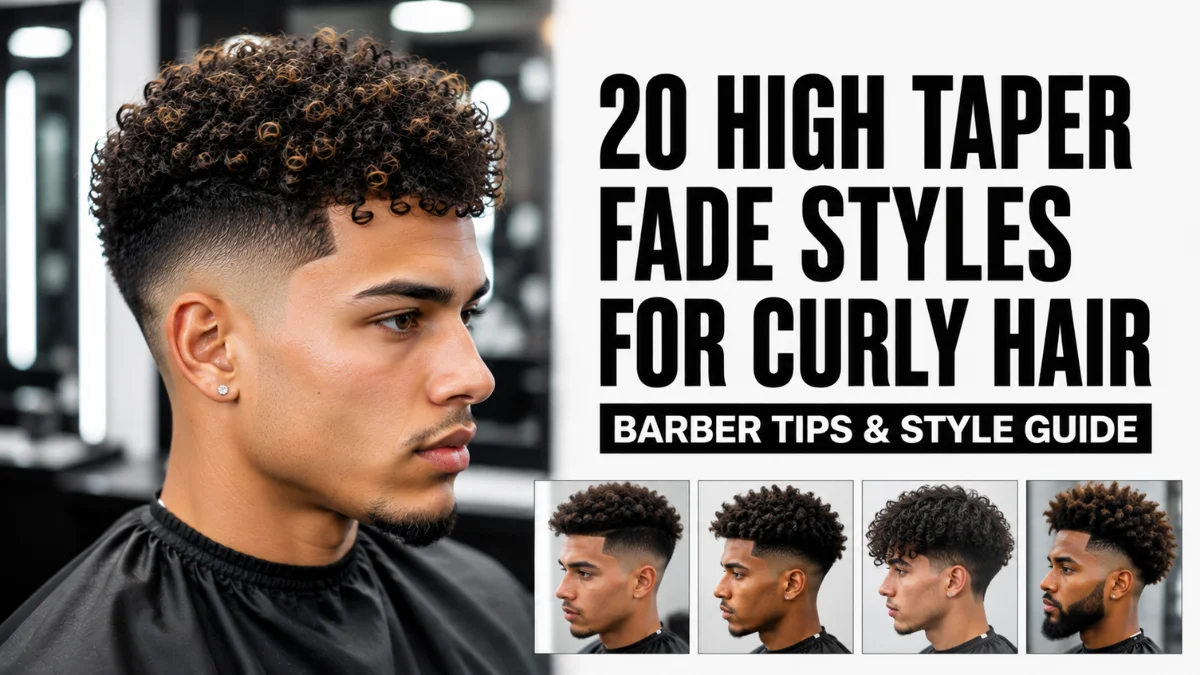
20 High Taper Fade Styles for Curly Hair: Best Looks, Barber Tips & 2026 Guide

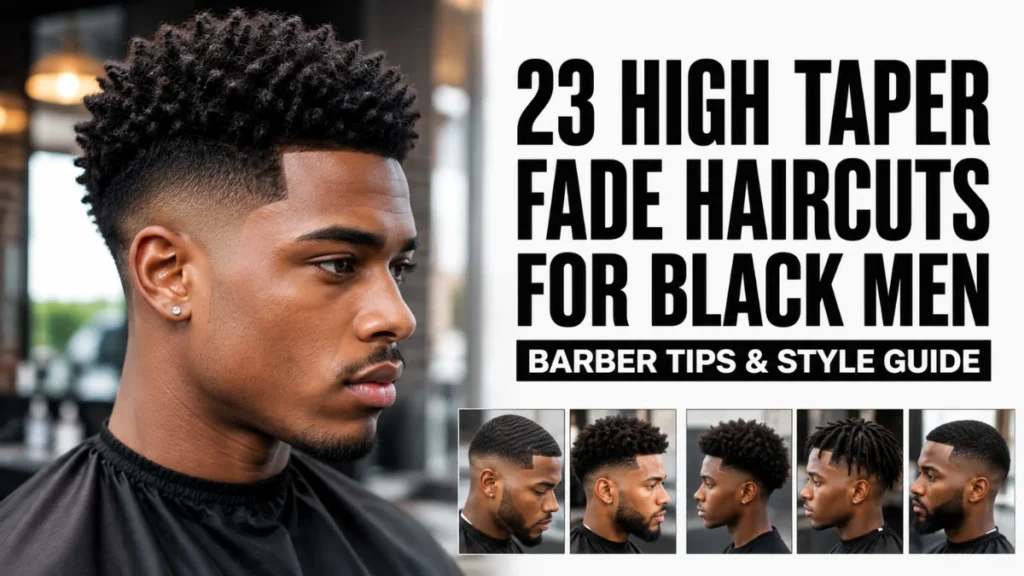
High taper fade styles are a strong match for curly hair because they create a clean, controlled perimeter while allowing the natural texture on top to remain the main feature. The elevated taper around the temples and upper sides adds definition without requiring the entire side of the head to be taken extremely short.
Curly hair needs a different approach from straight hair because curl formation, density, shrinkage, and growth direction can dramatically change the finished shape. A length that looks substantial before the curls contract may appear much shorter once the hair dries.
In 2026, modern curly haircuts are moving toward natural texture, personalized shapes, clean outlines, and fades tailored to the individual rather than copied exactly from a reference photo. That makes the barber’s understanding of curl behavior just as important as the clipper technique.
This guide covers the most useful high taper fade styles for curly hair, how to choose one for your curl pattern and face shape, what to tell your barber, how to style the top, and how to keep the haircut looking sharp between appointments.
What Are High Taper Fade Styles for Curly Hair?
High taper fade styles feature a taper that begins relatively high around the temple and upper side area while retaining more length toward the top. The shortest section can be finished at skin level, with a trimmer or with a clipper guard depending on the desired contrast.
The word “high” describes the taper’s placement. It does not automatically mean that the entire side of the head should be shaved down.
That distinction is important with curly hair because preserving some surrounding weight can help the transition look more natural. The barber can create a strong contrast without making the curly top appear disconnected.
Why High Taper Fade Styles Work With Curls?
Curly hair naturally provides volume, movement, and texture. A well-placed taper removes some visual weight around the temples while leaving the top free to form its natural pattern.
The result can be especially effective when the curls are defined rather than heavily manipulated. The shorter sides provide structure, while the top supplies most of the haircut’s personality.
Another advantage is versatility. The same basic taper can support short curls, longer curls, coils, curly fringes, textured crops, afros, mohawks, and other top shapes.
High Taper Fade vs. High Fade on Curly Hair
The terms can sometimes be used interchangeably in everyday barber conversations, but they can produce different silhouettes.
A high fade generally carries the shortened area farther across the sides. A high taper concentrates the strongest reduction around specific perimeter areas while allowing more surrounding hair to remain.
If you want your curls to remain the visual focus, a taper can offer strong contrast without removing as much side structure.
| Feature | High Taper Fade | High Fade |
|---|---|---|
| Main Focus | Temples and perimeter | Broader side area |
| Side Weight | Can retain more | Usually reduced more |
| Top Emphasis | Strong | Very strong |
| Curly Texture | Remains prominent | Creates stronger contrast |
| Overall Appearance | Controlled and sharp | More dramatic |
Because barber terminology varies, describe the actual shape you want instead of depending only on the haircut name.
20 Modern High Taper Fade Styles for Curly Hair
There is no single version that works for every curly-haired client. Your curl pattern, density, top length, face shape, and normal styling routine should influence the final choice.
1. High Taper Fade With Short Curls
Short curls provide a practical everyday option while still showing natural texture. The sides stay controlled, and the top remains long enough for the curl pattern to remain visible. This is a good choice if you want a clean haircut without spending a lot of time styling.
2. High Taper Fade With Defined Curls
Defined curls make the texture more noticeable and give the haircut a polished appearance. The barber should leave enough length for the curls to form properly. Taking the top too short can reduce definition and make the texture look compressed.
3. High Taper Fade With a Curly Top
A fuller curly top creates stronger contrast with the elevated taper. This style gives you more room to experiment with volume, direction, and curl definition. It also allows the barber to shape the top according to the natural contours of your head.
4. High Taper Fade With Loose Curls
Loose curls create a softer and more relaxed appearance. Keeping additional length on top allows the curls to move naturally, while the taper prevents the sides from becoming unnecessarily bulky.
5. High Taper Fade With Tight Curls
Tighter curls create a dense, textured appearance that works particularly well against clean tapered sides. The barber should consider shrinkage before removing significant length. Tight curls can look much shorter after drying than they do while damp or stretched.
6. High Taper Fade With Coils
Coils provide a compact texture with plenty of definition. A controlled taper can make the coil pattern stand out while keeping the overall shape neat. This combination works particularly well for men who want natural texture without a long top.
7. High Taper Fade With a Curly Fringe
A curly fringe allows part of the top to fall toward the forehead. The front should be cut according to the curl’s natural movement. Cutting the fringe too short can cause it to spring upward and produce a result that is different from what you expected.
8. High Taper Fade With a Curly Crop
A curly crop keeps the top relatively short while preserving enough texture to make the haircut interesting. It is a practical option for men who want natural curls without committing to substantial length or a complicated styling routine.
9. High Taper Fade With a Sponge-Curled Top
Sponge styling can create compact curls or coils with a distinctive textured finish. The top needs sufficient length for the technique to work effectively. If the hair is cut too short, there may not be enough movement to form the desired pattern.
10. High Taper Fade With a Short Afro
A short afro provides natural volume while the taper gives the sides a cleaner outline. The barber should shape the top according to its actual density rather than forcing every head into the same rounded or squared silhouette.
11. High Taper Fade With a Rounded Afro
A rounded afro creates a softer overall shape. The taper acts as the sharper element, while the curved top keeps the haircut natural. This combination is especially useful if you like visible volume without an overly geometric finish.
12. High Taper Fade With a Box-Shaped Curly Top
A more structured top creates stronger angles and a deliberate silhouette. This style requires careful attention to proportion. If the taper is too high or the top is too narrow, the haircut can lose its balance.
13. High Taper Fade With a Curly Mohawk
A curly mohawk concentrates volume through the center of the head while reducing the sides. Natural curls can make the center appear fuller without requiring excessive styling. This is a more expressive option and works best when the barber carefully controls the transition.
14. High Taper Fade With a Curly Faux Hawk
The faux hawk gives you some of the central emphasis of a mohawk while maintaining a softer overall shape. Curly texture naturally adds volume to the center, making this variation easier to personalize.
15. High Taper Fade With a Curly Caesar
A curly Caesar keeps the top compact and the front controlled. The elevated taper adds definition around the temples without requiring substantial styling. It can be a particularly practical option for men who prefer shorter hair.
16. High Taper Fade With a Line-Up
A clean line-up can make curly hair look immediately more structured. The important point is preserving the natural hairline. The barber should sharpen the existing perimeter rather than pushing the corners backward or creating an artificial shape.
17. High Taper Fade With a Beard
A beard gives the haircut additional visual weight around the lower face. The sideburn area should be blended according to the actual density of the beard. A subtle transition can look more natural than forcing a perfectly continuous connection.
18. High Taper Fade With a Full Beard
A fuller beard creates a stronger lower frame around the face. When paired with a curly top, the haircut can benefit from retaining enough volume above the taper so the overall proportions remain balanced.
19. High Taper Fade With a Curly Hard Part
A hard part creates a defined directional element through the haircut. It works best when positioned according to your natural growth pattern. If your curls strongly resist the direction of the part, maintaining the style may require more daily work.
20. High Taper Fade With a Curly Design
A small shaved or razor design can add individuality to the shortest section. Keep the design proportional to the rest of the haircut. When the top already has substantial texture, a simple design can often create enough detail without making the overall style look crowded.
Choosing the Right Style for Your Curl Pattern
Curl pattern gives you a starting point, but it is not the only factor that matters. Density, strand thickness, shrinkage, porosity, growth direction, and styling habits can all influence the haircut.
Type 2 Wavy Hair
Wavy hair benefits from keeping enough length for the natural bend to remain visible. A high taper can sharpen the perimeter while the top retains a loose, textured appearance.
Type 3A Curls
Loose curls can support longer tops, curly fringes, textured crops, and natural volume. The main consideration is preventing excessive width around the sides while preserving movement through the top.
Type 3B Curls
These curls have more spring and definition. A high taper can create noticeable contrast, especially when the top is shaped rather than simply cut to one uniform length.,
Type 3C Curls
Tighter curls provide substantial texture and can support both short and medium-length styles. Because the hair can contract significantly, the barber should consider how the top will look after it dries rather than judging the length only while the hair is wet.
Type 4A Coils
Defined coils can work with short crops, textured tops, sponge styling, and fuller shapes. The key is leaving sufficient length for the chosen texture to remain visible.
Type 4B and 4C Hair
Tighter coils often require particular attention to shrinkage and density. Do not choose the top length purely from a stretched measurement. Explain how you want the hair to look in its natural dry state so the barber can make a more appropriate adjustment.
Shrinkage: The Detail That Can Change the Entire Haircut
Shrinkage can make curly hair appear considerably shorter after it dries.
This is why a top that looks perfect while damp may suddenly appear too short once the curls contract. The effect varies between individuals, so there is no single percentage that should be applied to everyone.
If preserving length matters to you, tell your barber how you normally wear your curls and whether you want the final result judged by the dry curl pattern.
How to Choose the Right Taper Height?
A higher taper creates more contrast and draws attention toward the top.
That can be excellent when your curls have enough density and volume to support the shape. However, taking the taper excessively high can make the top appear disconnected or disproportionately large.
A Higher Taper May Suit You If:
- You want a noticeable contrast
- You prefer sharp temple definition
- Your curls provide enough top volume
- You like a modern, bold silhouette
- You want the sides to look visually lighter
A Lower Taper May Be Better If:
- You prefer more side weight
- You want a softer grow-out
- You are growing the sides
- You dislike dramatic contrast
- Your face or head already appears long
The best placement is determined by the entire shape of the head, not by the word “high” alone.
High Taper Fade Styles for Different Face Shapes
Face shape can help guide proportions, but it should never be treated as an inflexible rule.
- Round Face: Controlled height through the curly top can help create a more elongated visual impression. Avoid unnecessary width around the upper sides if you want the overall shape to appear narrower.
- Oval Face: An oval face generally gives you considerable flexibility. Short curls, medium-length texture, fuller tops, and different beard combinations can all work when the proportions are balanced.
- Square Face: A square face already has strong angular features. A clean taper can reinforce that structure, while a softer curly top can prevent the haircut from looking excessively rigid.
- Oblong Face: Be careful when combining a very high taper with extreme vertical volume. A curly top with controlled height and some natural width may produce a more balanced silhouette.
- Heart-Shaped Face: Consider the relationship between the forehead, temples, and chin. Rather than automatically adding height, focus on creating a proportionate shape that works with your natural curl volume.
Thick vs. Fine Curly Hair
Hair density can change how a taper should be built.
Thick Curly Hair
Thick curls give the barber plenty of material for shaping. The taper can remove some visual weight from the sides while the top maintains substantial volume. However, removing too much internal bulk is not always the solution because excessive thinning can change the way the curls form.
Fine Curly Hair
Fine curls require more careful weight management. If the sides are taken extremely short while the top lacks density, the contrast can make the top appear thinner. Preserving suitable top length and using a softer transition may create a fuller-looking result.
How to Tell Your Barber What You Want?
A haircut name is helpful, but it does not communicate every important detail.
Tell your barber:
- How high you want the taper
- Whether you want skin, shadow, or guard length
- How much curl you want to keep
- Whether you want a line-up
- How you want the neckline finished
- Whether you normally wear your curls natural or defined
- Whether you are growing the top
A clear request could be:
“I want a high taper fade around the temples and upper sides. Keep my curls full enough to show their natural pattern, preserve my natural hairline, and make sure the top still has enough length after it dries.”
A side-profile reference photo is particularly useful because it communicates the taper height better than a front-facing picture.
What Your Barber Should Assess Before Cutting
An experienced barber should look beyond the haircut reference.
- Curl Behavior: How tightly does the hair bend, and does the pattern change across the head?
- Density: Is the hair equally dense around the crown, temples, and sides?
- Growth Direction: Do the temple hairs grow forward, backward, outward, or in multiple directions?
- Hairline: Where does the natural front perimeter actually sit?
- Head Shape: Where does the skull widen, narrow, or change direction?
- Styling Routine: Will the curls be worn natural, brushed, sponged, diffused, finger-coiled, or styled with product?
These details can affect the final haircut more than the haircut name itself.
Styling High Taper Fade Styles With Curly Hair
The haircut creates the shape, but your styling routine determines how the curls actually look.
1. Start With Clean Hair
Use a cleansing routine that works for your scalp and curl pattern. Curly hair can respond differently to frequent washing, heavy products, and environmental conditions, so your routine should be based on how your hair and scalp behave rather than a rigid schedule.
2. Apply Product While Damp
Curl cream, leave-in conditioner, or another lightweight styling product can help with definition. Start with a small amount and distribute it evenly. You can always add more if necessary.
3. Encourage Your Natural Pattern
Depending on your curl type, you might use scrunching, finger coiling, brushing, or a curl sponge. Choose the technique that supports your existing texture instead of repeatedly forcing the hair into a pattern it does not naturally hold.
4. Let the Curls Set
Allow the hair to dry without excessive manipulation. If you use a diffuser, follow the equipment and product instructions and avoid excessive heat.
5. Avoid Product Buildup
A heavy layer of styling product can make curls look weighed down rather than defined. Cleanse and reset the hair when buildup begins affecting the texture.
How to Maintain the Taper?
There are two different maintenance tasks: keeping the fade clean and keeping the curls healthy and defined.
The taper becomes softer as the hair grows. A skin-level finish will usually make that change more noticeable than a guard finish.
Your curls also need their own routine involving appropriate cleansing, conditioning, moisture, and styling.
Between Barber Visits
You can extend the clean appearance by:
- Refreshing the curls when necessary
- Protecting the hair during sleep if appropriate
- Avoiding excessive dry brushing
- Keeping the top moisturized according to your routine
- Cleaning only the perimeter if you know how to do so safely
Avoid trying to rebuild the fade yourself unless you understand clipper blending. Cutting too high into the transition can create a visible line that is difficult to remove.
Conclusion
The best high taper fade styles for curly hair are built around the texture rather than imposed on it. The taper creates the clean framework, while the curls provide the volume, movement, and individuality.
Your ideal version depends on more than curl type. Taper height, top length, shrinkage, density, head shape, hairline, beard growth, styling habits, and maintenance expectations should all be considered before the first clipper pass.
Short defined curls can give you a practical everyday haircut, while medium or long curls can create much more dramatic contrast. Coils, fringes, afros, faux hawks, mohawks, textured crops, and natural curls all offer different ways to personalize the same fundamental concept.
Before your appointment, bring a clear side-view reference, explain how you normally wear your curls, and tell your barber how much maintenance you are realistically willing to do.
The strongest result is not the haircut that looks best on someone else. It is the version that fits your curl behavior, your proportions, and the way you actually live with your hair.