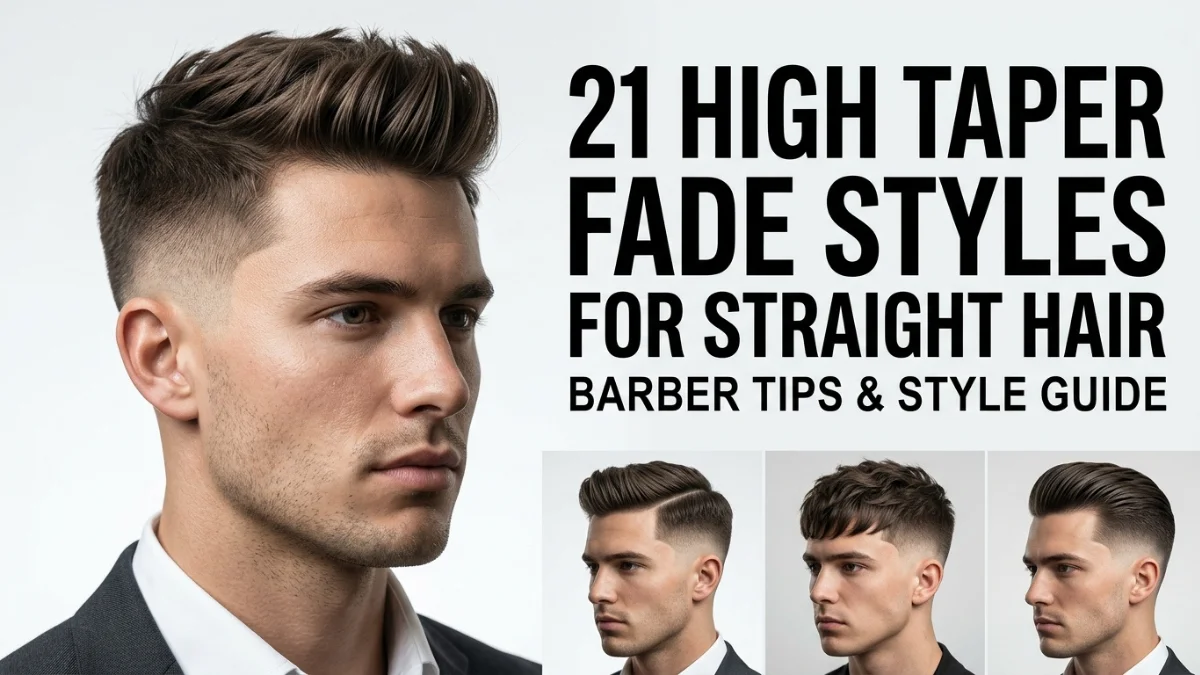
21 High Taper Fade Straight Hair Styles for Men & Barber Guide(2026)

A high taper fade straight hair haircut combines a noticeably elevated taper around the temples with straight hair that remains longer through the top. The contrast can make the haircut look exceptionally clean because straight strands tend to show changes in length and direction very clearly.
But straight hair is not automatically easy to cut. Fine strands can lack body, thick straight hair can become bulky, and strong growth patterns such as cowlicks can change how the finished top sits.
The best result comes from matching the taper to the density and behavior of the hair rather than simply choosing a reference photo. Current 2026 men’s haircut trends continue to favor personalized fades, textured finishes, natural movement, fringes, parts, and controlled volume instead of one rigid haircut formula.
This guide explains the best styles, how to choose the right taper height, what changes for fine or thick straight hair, how to communicate with your barber, and how to style and maintain the finished cut.
What Is a High Taper Fade for Straight Hair?
A high taper fade places the shortest part of the transition relatively high around the temples and upper side area while keeping more length through the top.
The taper can finish with a skin-close section, a trimmer finish, or a short clipper guard. The choice changes the amount of contrast and how quickly the haircut appears grown out.
With straight hair, the transition can look particularly precise because there is less natural curl or wave to soften the visual change between lengths. The top can then be styled in numerous directions, including forward, upward, backward, or toward a part.
Why Straight Hair Works So Well With a High Taper?
Straight hair provides a clean canvas for shaping.
When the sides are tapered high, the difference between the shorter perimeter and longer top becomes immediately visible. This can make simple hairstyles such as a textured crop or side part look more defined.
Straight hair also gives you flexibility. Depending on length and density, the top can become a fringe, quiff, slick back, pompadour, comb-over, middle part, brush-up, or relaxed textured style.
The challenge is that straight strands can reveal imperfections in the blend more easily. A poorly connected transition or uneven weight distribution may be more obvious than it would be in highly textured hair.
High Taper Fade vs. High Fade
The two terms are sometimes mixed together, but the cutting area can be different.
A high fade generally removes more of the side hair and carries the shortened section farther across the head. A high taper concentrates the strongest reduction around the temple and perimeter areas while allowing more surrounding structure to remain.
For straight hair, this distinction can make a major difference because the top and side lengths create a very visible contrast.
| Feature | High Taper Fade | High Fade |
|---|---|---|
| Shortest Area | Concentrated around taper zones | Broader side section |
| Side Weight | More can be preserved | Usually reduced more |
| Contrast | Strong | Very strong |
| Top Styling | Highly versatile | Often more prominent |
| Grow-Out | Depends on finish | Contrast can become noticeable quickly |
If your barber uses the terminology differently, explain exactly where you want the shortest section to sit.
21 Best High Taper Fade Styles for Straight Hair
Straight hair gives you a wide styling range. The right variation depends on how much length you want, how thick your hair is, and whether you prefer a polished or relaxed finish.
1. Textured High Taper Fade
A textured top prevents straight hair from looking overly flat or uniform. The barber can use strategic layering or texturizing to create separation, while a matte styling product can add movement without making the hair look greasy. This is a strong choice if you want a modern haircut that does not require a perfectly combed finish.
2. High Taper Fade With a Side Part
A side part adds direction and structure to straight hair. The taper keeps the sides controlled while the longer top follows a clear parting line. This can work particularly well for professional environments where you want a polished appearance. Your natural part should guide the placement rather than forcing the hair against its growth pattern.
3. High Taper Fade With a Slick Back
Longer straight hair can be brushed backward to create a clean, controlled silhouette. The taper reduces the visual weight around the sides while the top provides the length required for the backward flow. A slick back can be worn relatively natural or given more shine depending on your styling product.
4. High Taper Fade With a Quiff
A quiff adds height toward the front while the taper keeps the sides visually lighter. Straight hair can be useful for this style because it can hold a directed shape with the right length and styling technique. The barber should leave enough weight through the front so the quiff does not collapse immediately after styling.
5. High Taper Fade With a Brush-Up
The brush-up is a simpler alternative to a large quiff. The top is directed upward and slightly backward, creating height without requiring a highly sculpted shape. This works particularly well when the hair has moderate thickness and naturally responds to blow-drying.
6. High Taper Fade With a Textured Fringe
A fringe changes the direction of the top by bringing the hair forward. Straight hair can create a very defined fringe, but the front should be cut according to the natural fall of the hair. If the hair naturally separates or grows upward, the barber needs to account for that movement. A matte product can help create separation without making the fringe stiff.
7. High Taper Fade With a Blunt Fringe
A more solid front edge gives the haircut a stronger geometric appearance. This works best when your hair naturally falls forward, and you are comfortable maintaining a defined front shape. If your hairline is uneven or your hair naturally parts, a softer textured fringe may be easier to manage.
8. High Taper Fade With a French Crop
A French crop keeps the top relatively short while using the front section as the main styling feature. The high taper creates contrast without requiring a large amount of product or daily styling. This is a practical option for men who want a sharp haircut but do not want to spend much time creating volume.
9. High Taper Fade With a Caesar Cut
The Caesar keeps the top compact and directed forward. Straight hair makes the front shape particularly visible, so the barber should pay close attention to the hairline and the direction in which the fringe naturally falls. The taper adds a cleaner frame around the sides.
10. High Taper Fade With a Comb Over
A comb-over uses the longer top to create a directional sweep. It can be subtle and natural or more structured depending on the amount of product used. Straight hair generally makes the direction easy to establish, but a strong cowlick can influence which side works best.
11. High Taper Fade With a Middle Part
A middle part gives straight hair a relaxed, flowing appearance. The top needs enough length to separate naturally and fall toward both sides. This is better suited to medium-length straight hair than a very short crop because the part needs sufficient weight to hold its shape.
12. High Taper Fade With Curtains
Curtain-style hair can be paired with a cleaner taper to combine longer movement on top with sharper sides. This creates a modern contrast between a relaxed center part and a precise perimeter. The top usually needs more length than a traditional short fade style, so tell your barber if you are growing toward this look.
13. High Taper Fade With a Pompadour
A pompadour places significant emphasis on volume through the front and upper top. Straight, thick hair can provide the density needed for this shape, while the high taper reduces side bulk. A round brush and blow dryer can help build the initial shape before styling product is applied.
14. High Taper Fade With a Short Crop
A short crop minimizes styling while keeping the haircut structured. The top can be cut relatively evenly, with slight texture added to prevent it from appearing too uniform. The taper provides the main contrast.
15. High Taper Fade With a Long Top
Keeping the top longer creates more styling possibilities. You can switch between a side part, slick back, messy texture, quiff, or natural flow without immediately changing the haircut. The trade-off is greater daily maintenance and a longer grow-out period before the top reaches the desired shape.
16. High Taper Fade With a Messy Top
Straight hair does not have to look perfectly controlled. A deliberately messy top adds movement and a more casual personality. The key is creating texture rather than simply leaving the hair unstyled. A lightweight matte product can separate strands without producing a wet finish.
17. High Taper Fade With a Hard Part
A hard part creates a permanent-looking visual division between the shorter sides and longer top. It can make a straight haircut look extremely precise. Because the line grows out, this style requires more frequent barber attention than a natural part.
18. High Taper Fade With a Beard
Adding facial hair gives the haircut another layer of structure. The taper can transition into the sideburn area and then into the beard, creating a connected appearance. The blend should follow your natural beard density rather than forcing a uniform connection.
19. High Taper Fade for Thick Straight Hair
Thick straight hair gives you considerable styling flexibility, but it can also create unwanted bulk. If the sides retain too much weight above the taper, the haircut may appear wider than intended. Your barber can remove or redistribute some weight while keeping enough density through the top.
The top can support styles such as a quiff, pompadour, slick back, textured crop, or longer flow.
Do not assume that aggressively thinning thick hair is always the answer. Excessive thinning can remove the support needed for certain styles and may make the ends behave unpredictably as the haircut grows.
20. High Taper Fade for Fine Straight Hair
Fine straight hair requires a different approach. Because the strands have less visual bulk, taking the sides extremely close can contrast with the top appear stronger. In some cases, preserving strategic weight through the upper sides can make the haircut look more balanced.
Textured crops, short quiffs, side parts, and controlled brush-ups can work particularly well because they use direction and texture to create visual fullness.
Avoid relying on heavy, greasy products. They can separate fine strands and make the top appear flatter.
21. High Taper Fade for Medium-Density Straight Hair
Medium-density hair offers a useful middle ground. You can generally move between short textured styles and longer directional hairstyles without requiring extreme adjustments.
The key is deciding whether you want the top to look structured, natural, or deliberately messy before the barber determines the final length.
Choosing the Right Taper Height
The higher the taper sits, the more visual contrast you create between the top and sides. That can be excellent if you want a bold silhouette. However, a very high taper can make the top appear heavier, particularly when you have thick straight hair or substantial length.
A High Placement Works Well If:
- You want strong contrast
- You like clean temple definition
- You want to emphasize the top
- Your hairstyle uses noticeable volume
- You prefer a sharper appearance
A Lower Placement May Be Better If:
- You want more side weight
- You prefer subtle transitions
- You are growing the sides
- You want a softer grow-out
- Your top is already very short
The goal is not to make the taper as high as possible. It is to find the point where the shorter sides and longer top look proportionate.
How to Ask Your Barber for a High Taper Fade?
Avoid giving your barber only the haircut name. Explain the taper height, shortest finish, top length, front shape, and styling direction you want.
A useful request might be:
“I want a high taper fade around the temples and upper sides. Keep enough length on top for a textured side-swept style, preserve my natural hairline, and don’t take the taper higher than the point where the top still looks balanced.”
If you want skin at the shortest point, say so. If you prefer a softer finish, ask for a shadow or guard transition. A side-view reference photo is usually more useful than a front-facing image for communicating taper height.
What Your Barber Should Assess First
Before cutting straight hair, an experienced barber should check several things.
- Hair Density: Is the hair thick, medium, or fine?
- Growth Direction: Does the hair naturally move forward, backward, or toward one side?
- Cowlicks: Are there areas that lift or separate naturally?
- Head Shape: Where does the head widen or narrow?
- Hairline: Is the front naturally straight, rounded, uneven, or receding?
- Top Goal: Will you wear the hair forward, back, up, or parted?
These factors determine the correct shape more reliably than a generic haircut reference.
Face Shape and High Taper Fade Styles
Face shape can help guide the proportions, but there is no universal rule that says one haircut belongs exclusively to one face shape.
Round Face
A little controlled height through the top can create a more elongated visual effect. Keeping unnecessary side width under control can also help the overall silhouette appear cleaner.
Oval Face
Oval faces generally allow considerable flexibility. Short crops, side parts, quiffs, slick backs, textured tops, and medium-length styles can all work when the haircut is proportioned correctly.
Square Face
A square face already has strong structure. A high taper can reinforce that angular appearance, while a textured or slightly softer top can prevent the haircut from looking too rigid.
Oblong Face
Avoid automatically adding excessive vertical height. A textured top with moderate lift and some natural width can create a more balanced appearance.
Diamond Face
The cheekbones tend to be a prominent feature, so the haircut should be balanced around them. A controlled top with a clean taper can work well without adding unnecessary width around the upper sides.
Best Products for Straight Hair
The product should match both the hair density and the hairstyle.
- Fine Straight Hair: Lightweight paste, styling powder, or a light cream can provide control without collapsing the roots.
- Thick Straight Hair: A stronger clay, paste, or pomade can help manage density and hold a structured style.
- Medium-Density Hair: You have more flexibility. A matte cream or medium-hold paste can provide enough control for many everyday styles.
- Long Straight Hair: A lightweight styling cream can preserve movement, while a stronger product may be useful for slick backs or formal styling.
The key is using enough product to control the hair without coating it so heavily that the strands lose their natural movement.
Maintaining the Haircut
The taper and the top require different types of maintenance. The taper becomes softer as the hair grows, while the top may need regular washing, conditioning, trimming, and styling depending on its length.
A skin-close finish will generally reveal growth sooner than a guarded finish. If you want the haircut to remain extremely crisp, plan your barber visits around when the transition begins losing its intended shape.
Common Problems With Straight Hair Tapers
- The Sides Look Too Bulky: This often happens when thick straight hair retains too much weight above the taper. The solution may involve targeted weight removal rather than simply raising the taper.
- The Top Looks Flat: Fine straight hair may lack natural lift. Blow-drying with the correct direction and using a lightweight volumizing product can help create body without making the hair greasy.
- The Hair Separates Too Much: This can happen when the product is too heavy, or the hair is naturally fine. Use less product and distribute it more evenly through the top.
- The Taper Looks Uneven: Straight hair can make blending inconsistencies easier to see. The transition should be checked from multiple angles because lighting can exaggerate dark areas on one side.
- The Hairline Looks Artificial: A line-up should sharpen the natural perimeter rather than completely redraw it. Preserving the original corners often creates a better long-term result.
2026 Straight Hair Trends to Watch
Current 2026 men’s haircut coverage points toward more individualized styling, softer movement, textured finishes, fringes, middle parts, slick backs, and modern interpretations of classic shapes.
For straight hair, that trend is particularly useful because the texture can support both structured and relaxed looks.
Natural-Looking Texture
The modern textured haircut does not need to look artificially messy. Strategic cutting combined with lightweight product can create separation while allowing the straight hair to retain movement.
Modern Fringes
Fringes continue to offer a practical way to change the appearance of a short haircut without dramatically increasing top length. The important part is matching the fringe to the natural direction of the front hair.
Middle Parts and Longer Tops
Medium-length straight hair gives you more styling flexibility. A middle part, loose curtains, or natural flow can be combined with a cleaner taper to create contrast between relaxed movement and precise sides.
Softer Styling
The trend is not necessarily toward maximum shine or extreme hold. A controlled matte or natural finish often lets straight hair look more dimensional and less weighed down.
Personalized Taper Placement
The exact position of the taper should be adapted to the head and hairstyle. A high placement can create dramatic contrast, but the correct height is the one that makes the entire haircut look intentional.
Conclusion
The best high taper fade straight hair haircut is built around the way your hair naturally behaves. Straight strands can make the taper look exceptionally clean, but they also reveal problems with blending, weight distribution, hair direction, and uneven growth more easily.
Start by deciding what you want the top to do. A textured crop, side part, quiff, slick back, fringe, middle part, pompadour, or natural flow will each require a different amount of length and shaping.
Then choose the taper height and finish that support that goal. A skin finish creates stronger contrast, while a shadow or guard finish gives you a softer appearance and more forgiving grow-out.
Most importantly, do not ask your barber to reproduce someone else’s haircut exactly. Give them a useful reference, explain how your straight hair naturally grows, and describe how you want to wear it. The best haircut is the one that looks sharp when freshly styled and still makes sense when your hair is behaving like itself.