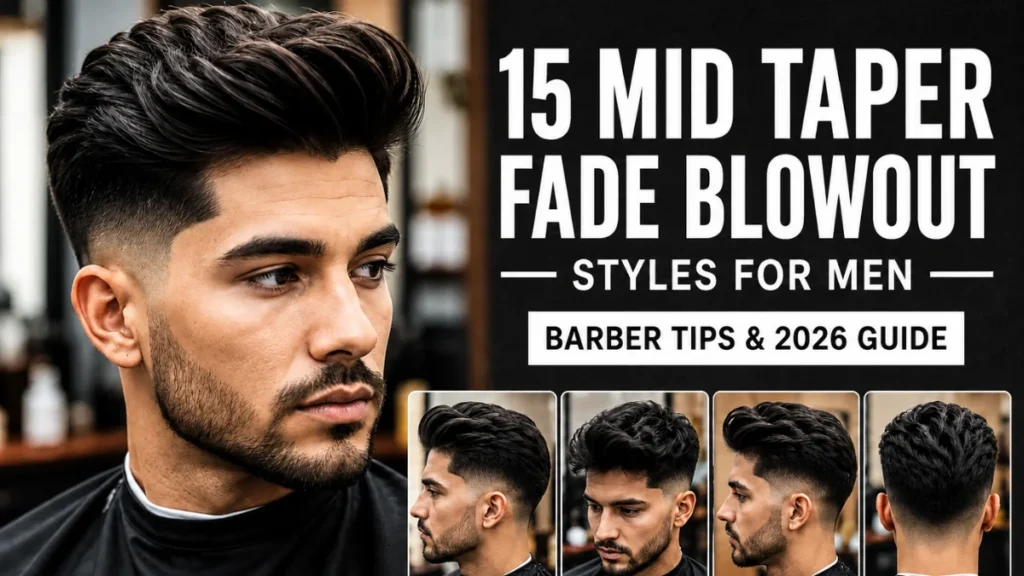
23 Best Mid Taper Fade Straight Haircuts for Men & Barber Guide (2026)

Straight hair gives a mid taper fade haircut a different character from curly or coily versions. Because straight strands naturally show direction, length changes, and weight distribution more clearly, the top can be shaped into everything from a clean side part to a textured crop, fringe, quiff, or longer flow.
The taper provides structure around the temples, sideburns, and neckline without necessarily taking away the natural shape of the sides. That makes it a useful option when you want a clean haircut but still want enough length to style the top in different ways.
Men’s grooming in 2026 is also moving toward more relaxed texture, longer growth, softer edges, and personalized versions of classic cuts. Current trend coverage points to a shift away from excessively polished, identical-looking styles and toward hair that retains movement and individuality.
What Is a Mid Taper Fade for Straight Hair?
A mid taper gradually shortens the hair around the middle portion of the temple and sideburn area, with the transition continuing toward the neckline. Unlike a broad mid fade, the taper can leave much of the side panel intact.
That difference is especially useful with straight hair because straight strands can reveal the exact shape of the haircut. Preserving some side weight can make the transition look more natural and keep the top connected to the overall silhouette.
The finished result depends on your hair’s thickness, direction of growth, length, hairline, head shape, and styling preference. A good barber should adjust the taper rather than applying the same placement to every client.
Why Straight Hair Works Well With a Mid Taper?
Straight hair is naturally versatile because it can be brushed forward, swept sideways, pushed back, lifted upward, or allowed to fall naturally. The mid taper gives those different top styles a cleaner perimeter.
It can also help control visual weight around the ears and temples without forcing the entire haircut into a high-contrast fade. That makes it suitable for both conservative cuts and more fashion-forward textured styles.
Another advantage is that straight hair shows shape clearly. If the top is layered correctly, the movement and separation can remain visible without requiring a large amount of styling product.
Mid Taper vs. Mid Fade
These two terms are often confused, but the cutting area can be different.
A mid fade generally reduces more of the side panel, creating a stronger transition from short to long hair. A mid taper is more concentrated around the temple, sideburn, and neckline, allowing more of the natural side shape to remain.
| Feature | Mid Taper | Mid Fade |
|---|---|---|
| Main Focus | Temple, sideburn, neckline | Larger side and back area |
| Side Coverage | More preserved | More reduced |
| Overall Contrast | Moderate | Stronger |
| Top Versatility | Very high | High |
| Natural Silhouette | More preserved | More altered |
| Grow-Out Appearance | Usually softer | Usually more noticeable |
If you want the sides to retain some weight, explain that to your barber rather than relying only on the word “fade.”
23 Trending Mid Taper Fade Straight Haircuts for Men
Straight hair gives you plenty of room to change the personality of the haircut through top length and styling direction. These variations are not separate haircuts in every case; several can be adapted from the same basic taper by changing the top shape.
1. Classic Straight Top With Mid Taper
Keep the top moderately short and let the straight strands follow their natural direction. The taper cleans the perimeter while the top remains simple and easy to manage.
This is a strong starting point if you want a haircut that works for school, work, and casual settings without requiring elaborate styling.
Best for: Medium-density straight hair and low-to-moderate styling effort.
2. Mid Taper With Textured Crop
A textured crop adds separation to otherwise straight strands. Instead of allowing the top to sit as one flat block, the barber can create controlled variation through the length. A matte styling product can emphasize the texture without making the hair look overly glossy.
3. Mid Taper With Straight Fringe
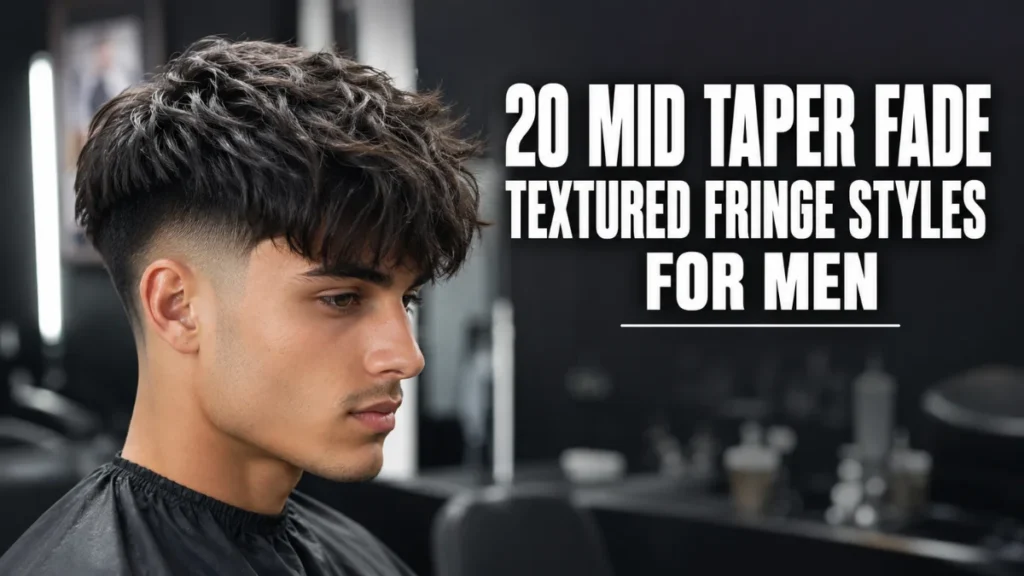
The fringe can be worn naturally across the forehead or shaped into a slightly uneven, textured front. The taper keeps the sides clean while the front becomes the main visual feature. This is particularly useful if you prefer a haircut that does not expose the entire forehead.
4. Mid Taper With Side Part
A side part adds direction and structure to straight hair. The taper provides a clean foundation while the top can remain long enough to comb into place.
For a traditional appearance, use a small amount of medium-hold product. For a more current finish, allow some natural separation rather than making every strand perfectly flat.
5. Mid Taper With Hard Part
A hard part creates a more obvious dividing line between the two sections of the hairstyle. It produces stronger definition than a natural side part.
This option requires more commitment because the shaved or strongly defined part becomes part of the haircut’s design. Make sure you want that detail before asking your barber for it.
6. Mid Taper With Quiff
Straight hair is particularly suitable for a quiff because the strands can be directed upward and backward. The mid taper reduces bulk around the sides while the front provides height.
The amount of height should match your face shape and hair density. More height is not automatically better.
7. Mid Taper With Low Quiff
A lower quiff creates a more understated profile than a tall, dramatic version. It works well if you want some lift at the front without making the hairstyle the center of attention. Use a blow dryer to establish direction, then apply a small amount of styling product for control.
8. Mid Taper With Slick Back
Longer straight hair can be brushed backward for a clean, mature appearance. The taper keeps the temples and neckline controlled while the top carries the length. A lighter product creates movement, while a stronger pomade can produce a more traditional slick finish.
9. Mid Taper With Brushed-Back Texture
Instead of completely flattening the hair, brush it backward while allowing some separation to remain. This creates a softer version of the slick-back style.
It fits the broader 2026 movement toward hair with visible movement rather than overly rigid styling.
10. Mid Taper With Messy Straight Hair
Straight hair does not have to look perfectly controlled. Strategic layering and a lightweight matte product can create a deliberately undone appearance. The important distinction is between messy styling and a poorly shaped haircut. The underlying cut should still have clear proportions.
11. Mid Taper With Curtain Fringe
A curtain fringe divides the front section toward the sides, exposing some of the forehead while framing the face.
This style works especially well when the top has enough length to fall naturally. It can also be adapted into a softer 1990s-inspired look, a direction that has been visible in 2026 men’s hair trends.
12. Mid Taper With Caesar Cut
A short Caesar keeps the top compact and places emphasis on the front edge. Straight hair makes the forward direction particularly visible. The taper prevents the short sides from looking too heavy around the ears while maintaining a clean overall outline.
13. Mid Taper With Ivy League
An Ivy League combines a relatively short cut with enough front length to create a controlled side-swept style. The mid taper makes the haircut more contemporary without removing the conservative character of the top.
14. Mid Taper With Pompadour
A pompadour uses greater length and volume at the front and upper section. Straight hair can make the shape easier to direct, although thicker hair may require more preparation and hold.
This is better suited to someone who enjoys styling rather than someone looking for a completely wash-and-go haircut.
15. Mid Taper With Bro Flow
A longer straight top can be allowed to move backward and naturally toward the sides. The taper keeps the perimeter from becoming too heavy while the longer top provides movement.
This style is especially useful during a grow-out because the taper can remain controlled while the top gains length.
16. Mid Taper With Straight Shag
A straight shag uses layers to create movement rather than relying on curls or waves. The taper around the temples can modernize the shape while leaving enough length through the top and back.
The 2026 trend toward longer, more relaxed men’s hairstyles makes this an interesting option for someone moving away from very short cuts.
17. Mid Taper With Mini Mullet
A mini mullet keeps additional length toward the back while the front and sides remain controlled.
A mid taper can make the temple area cleaner without eliminating the rear length that gives the style its identity. Current men’s hair trends continue to favor more wearable, less severe versions of the mullet.
18. Mid Taper With Textured Fringe
The textured fringe adds movement to straight hair that might otherwise sit too uniformly. Point cutting or other texture-focused techniques can help the front look less heavy.
The fringe length should be chosen according to your forehead, face shape, and how much maintenance you are willing to do.
19. Mid Taper With Long Top
Keeping considerable length on top gives you several styling options. You can wear the hair forward, backward, parted, or slightly off-center. The taper acts as the consistent foundation while the top can change as your hair grows.
20. Mid Taper With Short Straight Top
A short top is the practical end of the spectrum. It minimizes styling while the taper and hairline provide most of the haircut’s definition. This works especially well for straight hair that tends to lie flat and does not naturally create much volume.
21. Mid Taper With Spiky Texture
Short straight hair can be styled into separated spikes or a more irregular textured finish. A matte clay or paste usually makes more sense than a heavy shine product when you want the individual sections to remain visible. Keep the spikes controlled rather than creating a uniform row of rigid points.
22. Mid Taper With Side-Swept Top
A side-swept top is less formal than a hard-parted style but still gives straight hair a clear direction. It can be particularly useful for medium-length hair because the styling direction helps prevent the top from falling randomly across the face.
23. Mid Taper With Natural Flow
Let the straight hair fall according to its natural growth pattern while using the taper to control the perimeter.
This is one of the easiest variations to maintain and fits the current preference for hairstyles that look intentional without appearing overly manufactured. Recent men’s grooming coverage has highlighted more relaxed, natural-looking silhouettes as an alternative to the highly polished fade-heavy aesthetic of previous years.
How to Choose the Right Style for Straight Hair?
Straight hair can be fine, medium, or coarse, and each behaves differently after cutting. Density is often just as important as strand thickness because two men with straight hair can have completely different amounts of hair.
Your preferred styling routine also matters. A long quiff may look excellent but require daily blow-drying, while a short crop may achieve a similar polished appearance with considerably less effort.
Before choosing a reference photo, consider these five factors:
- Hair density: How much hair you have across the scalp.
- Strand thickness: Fine, medium, or coarse individual strands.
- Natural direction: Whether the hair falls forward, backward, sideways, or in several directions.
- Top length: Short, medium, or long.
- Maintenance level: How much daily styling you actually want to do.
Mid Taper for Fine Straight Hair
Fine straight hair can appear flatter because the individual strands do not provide as much visual bulk. A shorter, textured top can help create the impression of separation and movement.
Avoid automatically asking for heavy thinning. Removing too much material from already fine hair can make the top appear even less substantial.
A lightweight volumizing product and controlled blow-drying can provide lift without making the hair greasy or overloaded.
Mid Taper for Thick Straight Hair
Thick straight hair often gives you excellent styling flexibility, but it can become bulky around the sides and crown.
The barber should focus on shape rather than simply removing large amounts of hair. Strategic weight removal can help the top sit correctly while maintaining enough density for styling.
If your hair naturally expands outward, a slightly longer taper transition may preserve a more balanced silhouette.
Mid Taper for Coarse Straight Hair
Coarse straight hair can have substantial weight and may resist certain styling directions. Longer top sections often need more preparation and stronger hold to stay in place. A good barber should account for the hair’s natural resistance before deciding on the top length.
If you want a low-maintenance haircut, keeping the top shorter can make the daily routine considerably easier.
Best Face Shapes for a Mid Taper Fade With Straight Hair
A mid taper can be adapted to nearly any face shape because the barber can change the top’s height, width, and direction.
| Face Shape | Styles to Consider | Proportion to Watch |
|---|---|---|
| Oval | Most variations | Keep the overall shape balanced |
| Round | Quiff, textured top, side sweep | Add controlled height |
| Square | Crop, side part, short top | Preserve natural angularity |
| Oblong | Fringe, side-swept top, fuller sides | Avoid excessive vertical height |
| Diamond | Fringe, textured crop, medium top | Add balance around forehead and jaw |
| Heart | Side-swept fringe, moderate volume | Avoid excessive crown height |
These are starting points rather than strict rules. Hair density and personal style can easily change which version works best.
How to Ask Your Barber for a Mid Taper?
Simply saying “mid taper fade” does not communicate enough information.
Tell your barber:
- How much length you want on top.
- Where you want the taper to sit around the temple.
- Whether you want a natural or sharp hairline.
- How you want the neckline finished.
- Whether you want the sideburn connected to your beard.
- How you normally style the top.
A useful request could be:
“I want the taper around the middle of the temple and sideburn area, but I want to keep most of the side panel. Leave enough length on top for a textured side-swept style and keep the front close to its natural shape.”
Then show your barber a photo with similar hair density and length. A reference that matches your hair type is much more useful than a picture where the model has completely different density or head proportions.
Barber Techniques That Matter With Straight Hair
The quality of the haircut depends on how the barber manages the transition between the taper and the longer hair.
Establish the Shape Before Removing Excess Length
The barber should understand the finished silhouette before taking significant length away. Straight hair can expose uneven weight distribution more readily than highly textured hair.
Preserve the Right Amount of Side Weight
A taper should not automatically remove everything around the side panel. Leaving controlled weight can help the top transition more naturally into the sides.
Use Texture Where It Actually Helps
Straight hair can look flat if the top is cut as one uniform block. Strategic texture can create movement, but excessive texturizing can make fine hair look weaker.
Account for Growth Direction
Cowlicks and unusual growth patterns can change how the finished haircut sits. The barber should identify these areas before deciding where to remove weight.
Refine the Perimeter Last
The hairline, temple corners, sideburns, and neckline should be cleaned after the primary shape is established. This keeps the details working with the haircut rather than defining the haircut by themselves.
Styling a Mid Taper Fade With Straight Hair
Straight hair usually responds well to directional styling because the strands naturally follow a path once trained with heat and product.
- For a Natural Finish: Start with damp hair, apply a lightweight styling cream, and allow the hair to dry while following its natural direction.
- For Volume: Use a blow dryer at the roots while lifting the hair with a brush or your fingers. Apply product after the main shape has been established.
- For Texture: Use a small amount of matte clay, paste, or another texture-focused product. Work it through the top rather than coating the hair heavily.
- For a Side Part: Dry the hair in the direction you want the part to sit. A comb can establish a clean separation, while your fingers can soften the finished appearance.
- For a Slick Finish: Use a product with enough hold and shine to keep the top controlled. Apply gradually because excessive product can make straight hair appear greasy or flat.
Products for Straight Hair
There is no need to build a complicated shelf of styling products. Choose according to the finish you want.
| Styling Goal | Product Category | Why It Works |
|---|---|---|
| Natural Control | Styling cream | Flexible and understated |
| Matte Texture | Clay or paste | Adds separation and hold |
| Volume | Volumizing mousse | Lightweight lift |
| Strong Hold | Pomade | Keeps structured styles in place |
| Light Definition | Sea salt spray | Adds texture and movement |
| Flexible Hold | Styling wax | Allows restyling |
Fine straight hair generally benefits from lighter formulas, while thick hair may require more hold. Start with a small amount and add only what is necessary.
Mid Taper Fade Maintenance
The taper itself is relatively straightforward to maintain, but the top may require more attention depending on the style.
A short textured crop can remain practical for longer, while a hard part, quiff, slick back, or longer top may need more frequent reshaping.
There is no universal haircut schedule because growth rate, taper closeness, hair density, and personal standards of neatness vary. A softer taper can also remain presentable as it grows because the transition is less dependent on an extremely close finish.
Between Barber Visits
- Keep the scalp clean according to your normal routine.
- Use conditioner if your hair becomes dry or difficult to manage.
- Avoid applying heavy product every day when it is not necessary.
- Brush or comb according to the style rather than repeatedly disturbing the hair.
- Protect longer hair from unnecessary friction while sleeping.
- Ask for a perimeter cleanup when the temples or neckline lose their intended shape.
How Long Does a Mid Taper Fade Stay Fresh?
That depends on how quickly your hair grows and how precise you want the taper to look.
A very close taper will show new growth sooner than a softer transition. Your top style can also influence how quickly the haircut appears to need attention.
Rather than following a rigid appointment schedule, pay attention to when the temple, sideburn, and neckline no longer match the shape you want.
Common Mistakes With Straight Hair
Taking Too Much From the Sides
Straight hair often relies on controlled side weight to connect the top with the taper. Removing too much can create an unnecessarily disconnected appearance.
Over-Thinning Fine Hair
Fine straight hair can lose visual density when excessively thinned. Texture should be added selectively rather than automatically applied throughout the entire top.
Cutting the Top Too Short
If you want a side part, quiff, fringe, or brushed-back style, you need enough length to create that direction. Tell your barber what you want to do with the hair after the haircut before deciding on the top length.
Making the Taper Too High
A taper that climbs too far into the side panel can change the haircut from subtle to high contrast. If preserving the natural silhouette is important, specify that you want the taper concentrated around the perimeter.
Using Too Much Shine Product
Heavy pomades can flatten straight hair, particularly when the hair is fine. Choose the product according to the desired finish rather than assuming stronger shine equals better styling.
Ignoring the Cowlick
A strong cowlick can push the hair in an unexpected direction after it dries. Your barber should account for it when deciding the top length and layering.
Who Should Get a Mid Taper Fade With Straight Hair?
This haircut is a strong option if you want:
- Clean temples without an aggressive full-side fade.
- Enough top length for different hairstyles.
- A haircut that can look professional or casual.
- A manageable perimeter during a longer grow-out.
- A natural-looking transition around the ears and neckline.
- Flexibility with side parts, fringes, crops, quiffs, and longer styles.
You may prefer a different haircut if you specifically want maximum skin-level contrast across the sides or if you want a completely uniform short cut with almost no styling.
Pros and Cons
| Advantages | Considerations |
|---|---|
| Works with many straight-hair styles | Longer tops need more styling |
| Preserves more side structure | Poor taper placement can look disconnected |
| Easy to personalize | Fine hair can be over-thinned |
| Works with short or long tops | Hard parts require more commitment |
| Can support a grow-out | Very sharp tapers need regular cleanup |
| Suits natural or polished styling | Straight hair can expose uneven cutting |
FAQ
Is a mid taper fade good for straight hair?
Yes. Straight hair is highly adaptable and can support crops, fringes, side parts, quiffs, slick backs, longer flows, and textured styles.
What top length works best?
There is no universal ideal length. Choose the top based on your desired style, density, hair direction, and how much daily styling you want to do.
Can I combine a mid taper with a fringe?
Absolutely. A straight fringe can be short and structured or longer and textured. The taper provides contrast around the sides while the fringe frames the face.
Can I grow out a mid taper fade?
Yes. The taper can serve as a controlled perimeter while the top gains length. This is particularly useful if you are transitioning toward a longer flow, shag, or mini mullet.
Conclusion
The best mid taper fade straight hair haircut is not necessarily the sharpest or shortest version. Straight hair gives you the advantage of movement and styling flexibility, so the taper should create structure while allowing the top to retain its character.
A short crop can keep things simple, while a side part, fringe, quiff, slick back, textured flow, or mini mullet can give the same basic taper a completely different personality.
For 2026, the most relevant approach is personalization: preserve the amount of length your hair needs, use texture where it improves the shape, and avoid making the taper more aggressive than necessary. With the right proportions, the haircut can look clean immediately after the appointment and still grow out naturally.